
Your Brain on Iron: Why Lifting Heavy Is the Mental Health Tool Women 35-55 Actually Need
If you’re between 35 and 55, you’ve probably felt it - that subtle but persistent brain fog that rolls in mid-afternoon, the shorter fuse, or the low hum of anxiety that seems to follow you through your day. Whether you’re a new mom in your late 30s running on broken sleep and sheer willpower, or you’re navigating the unpredictable shifts of perimenopause, one thing is true: your brain is in the middle of a significant hormonal recalibration.
You’ve likely been told to try yoga, meditate more, or simply “practice self-care.” And while rest and mindfulness absolutely have their place, there is a powerful, deeply researched tool that does something yoga rarely can: it changes your brain chemistry at a structural level.
That tool is lifting heavy weights.
Before you scroll past, this is not about becoming a bodybuilder or spending your life in a gym. This is about understanding what happens inside your brain and body when you pick up something genuinely challenging, and why that experience is one of the most impactful things a woman in this life stage can do for her mental and cognitive health.
First, Let’s Define “Heavy”
When researchers study the brain benefits of strength training, they’re not talking about light, high-repetition workouts. They’re studying what happens when you genuinely challenge your muscles - weights that feel difficult by the last few repetitions, not weights you could lift for 30 reps without breaking a sweat.
That distinction matters, because the neurological response is tied to the intensity of the effort. The heavier the load (relative to your personal capacity), the more pronounced the brain’s response. And that response is remarkable.
The Brain Chemistry of a Heavy Lift
1. BDNF: The "Miracle-Gro" for Your Neurons
One of the most exciting areas of exercise science right now involves a protein called Brain-Derived Neurotrophic Factor, or BDNF. Think of it as fertilizer for your brain cells. BDNF supports the growth, repair, and maintenance of neurons, and research consistently shows that resistance training, particularly at higher intensities, increases its production.
This matters enormously for women in perimenopause. Declining estrogen affects the brain’s ability to maintain its plasticity - the flexible, adaptive quality that keeps us sharp, emotionally regulated, and resilient to cognitive aging. BDNF helps counteract that decline. A 2017 review in the journal NeuroImage found that resistance training was associated with significant improvements in cognitive function, particularly in memory and executive function - the exact things many women in this life stage feel slipping.
2. Dopamine and Norepinephrine - Your Brain’s Natural Focus System
Heavy lifting requires intense focus. This triggers the release of dopamine and norepinephrine, which act like a natural dose of Ritalin. It sharpens your focus, clears the fog, and provides a sense of accomplishment that carries over into your work and home life.
3. Your Stress Response - Trained, Not Tamed
This one surprises people: lifting heavy is, in the short term, a stressor. Your body experiences it as a challenge and responds accordingly - cortisol rises, your heart rate increases, your system mobilizes.
But here’s what’s fascinating: when this happens repeatedly, in a controlled way, it trains your Hypothalamic-Pituitary-Adrenal (HPA) axis - the system that governs your stress response - to become more efficient and balanced. Research suggests that people who strength train regularly show a more measured cortisol response to everyday stressors. Essentially, you’re practicing resilience in a very literal, physiological sense.
When life throws a difficult moment at you - a screaming toddler, a difficult conversation at work, an anxiety spiral at 2am - a well-trained stress response makes you genuinely more capable of handling it. That’s not a metaphor. That’s biology.
Why This Life Stage Changes Everything
During this life stage, our estrogen- a key neuroprotective hormone- begins to fluctuate and eventually drops. Estrogen plays a massive role in how our brain uses glucose for energy. When it dips, we feel tired and irritable.
Strength training fills the gap. It improves insulin sensitivity and provides a non-hormonal way to boost the neurotransmitters that estrogen is used to manage.
For women navigating different parts of this life stage, that looks like:
The new mom (35+): Postpartum hormonal shifts can leave your brain feeling genuinely different - slower, foggier, more emotionally reactive. Strength training helps rebuild the neurochemical scaffolding that supports mood, focus, and energy. It also rebuilds functional physical strength in a way that makes daily life - carrying a car seat, getting up off the floor, carrying a sleeping child - genuinely easier.
The perimenopausal woman: The mood swings, the low-grade anxiety, the sense of being slightly outside yourself - these are real. Strength training provides a reliable, repeatable way to stabilize your neurochemistry, work through emotional intensity, and feel grounded in your body at a time when it’s changing faster than you can track.
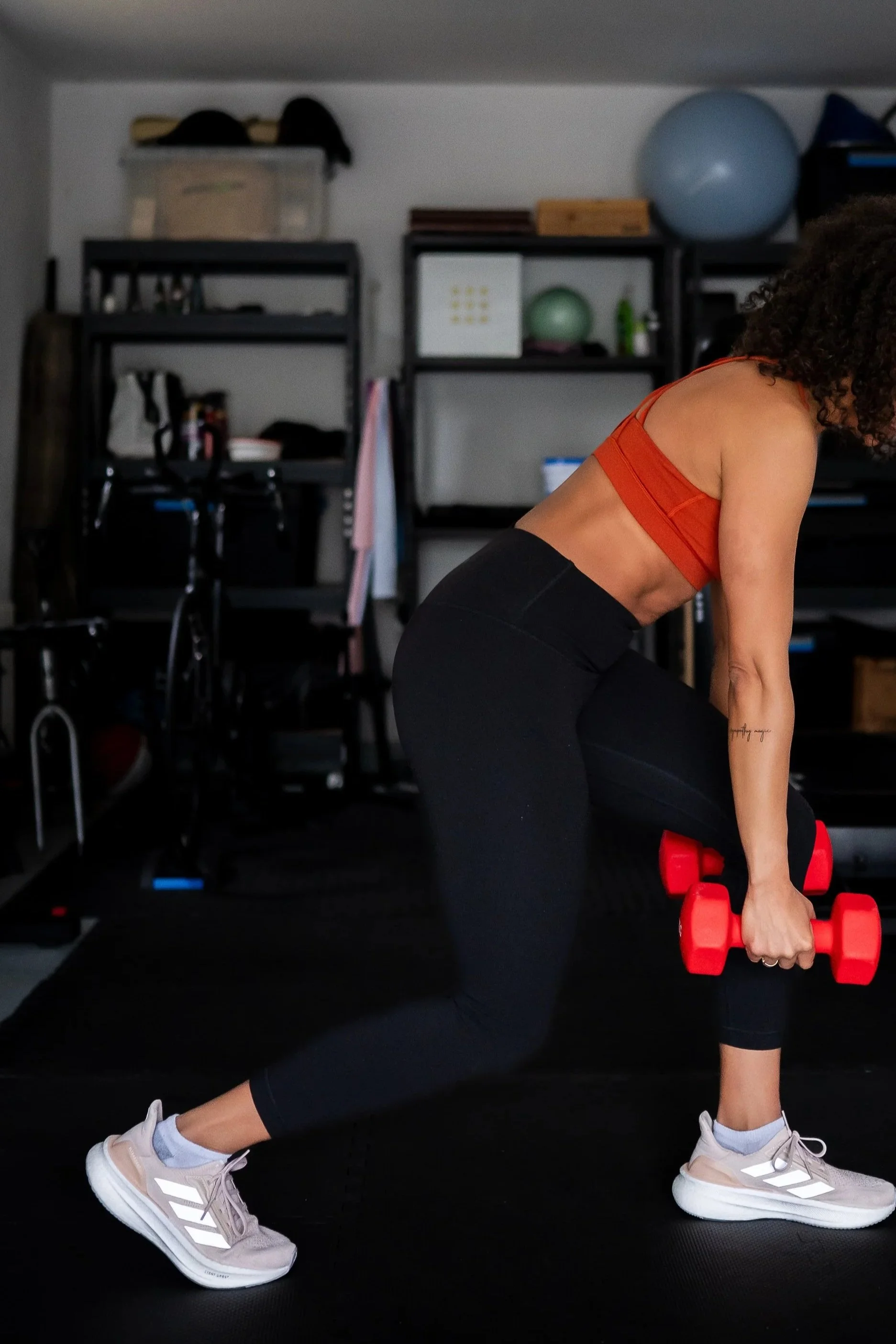
Reverse lunge with weights
How to Begin (Without Overwhelming Yourself)
You do not need to overhaul your life. You don’t need to join a powerlifting club or spend hours in the gym. The research suggests that for meaningful neurological benefit, the sweet spot looks something like this:
2–3 sessions per week, each lasting 30–50 minutes. That’s it.
Compound movements: Squats, deadlifts, presses, and rows. These involve the most muscle mass, which triggers the largest neurological response. They also translate directly into real-life strength.
Progressive overload: Aim to get slightly stronger over time - even by small increments. That consistent experience of progress is itself a neurological event. It builds confidence, signals competence to your brain, and produces a quiet, durable sense of self-efficacy that spills over into everything else you do.
If you’ve never lifted before, that is completely fine - and honestly, it’s not as complicated as it can look. A few sessions with a knowledgeable coach to learn the foundational movements safely is one of the best investments you can make. Start where you are. The weight will go up from there.
A Final Thought: This Was Always for You
For a long time, the weight room was culturally coded as a space for men. Women were steered toward the cardio machines, the light weights, the classes on the far side of the gym. That messaging did real harm - it kept women away from one of the most effective tools for long-term brain health, bone density, metabolic function, and mood.
The research is now unambiguous: women, particularly women in midlife, have the most to gain from strength training. Not just physically - though those benefits are significant - but mentally, emotionally, and neurologically.
Lifting heavy isn’t about changing how you look. It’s about changing how your brain works, how your body feels, and how you move through the world. When you discover that you can lift something heavy off the floor - really heavy - the weight of everything else has a way of feeling a little more manageable.
You were always strong enough for this. You just need someone to open the door.
